Theory
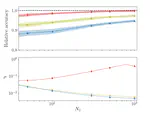
Finite-width one hidden layer networks display nontrivial output-output correlations that vanish in the lazy-training infinite-width limit. This manuscript rationalizes this evidence using kernel shape renormalization in the proportional limit of Bayesian deep learning.
We introduce a new method for training deep neural networks by focusing on the spectral space, rather than the traditional node space. It involves adjusting the eigenvalues and eigenvectors of transfer operators, offering improved performance over standard methods with an equivalent number of parameters.
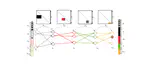
This study presents a variant of spectral learning for deep neural networks, where adjusting two sets of eigenvalues for each layer mapping significantly enhances network performance with fewer trainable parameters. This method, inspired by homeostatic plasticity, offers a computationally efficient alternative to conventional training, achieving comparable results with a simpler parameter setup. It also enables the creation of sparser networks with impressive classification abilities.