Dynamical Learning
This research introduces a learning algorithm based on the Wilson-Cowan model for metapopulation, a neural mass network model that treats different subcortical regions of the brain as connected nodes. The model incorporates stable attractors into its dynamics, enabling it to solve various classification tasks. The algorithm is tested on datasets such as MNIST, Fashion MNIST, CIFAR-10, and TF-FLOWERS, as well as in combination with a transformer architecture (BERT) on IMDB, achieving high classification accuracy.
EODECAs, merging machine learning with dynamical systems, enhance interpretability and transparency in neural networks. They employ continuous ordinary differential equations, offering both high classification accuracy and an understanding of data processes, addressing the opacity of traditional deep learning models. This approach signifies a step towards more comprehensible machine learning models.
The Complex Recurrent Spectral Network (C-RSN) is a novel AI model that more accurately mimics biological neural processes using localized non-linearity, complex eigenvalues, and separated memory/input functionalities. It demonstrates dynamic, oscillatory behavior akin to biological cognition and effectively classifies data, as shown in tests with the MNIST dataset.
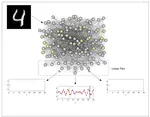
The Recurrent Spectral Network (RSN) is a new automated classification method that uses dynamical systems to direct data to specific targets, demonstrating effectiveness with both a simple model and a standard image processing dataset.