




Klara Bonneau, Jonas Lederer, Clark Templeton, David Rosenberger, Lorenzo Giambagli, Klaus-Robert Muller, Cecilia Clementi
October, 2025
Nature Communications
Lorenzo Giambagli
Marie Skłodowska-Curie Fellow
Department of Biophysics & AI4Science
Freie Universität Berlin
Hello World!
I’m Lorenzo, Post Doctoral researcher at Freie Universität Berlin, in Prof. Cecilia Clementi’s group. I am particularly fascinated by how many interacting objects can lead to some unexpected and complex behaviors.
I’ve been particularly focusing on Simplicial Complexes and Deep Learning, exploring the diverse facets of both fields. In the realm of Simplicial Complexes, my interest lies in the intricate relationship between topology and dynamics. As for Deep Learning, my focus is on pinpointing the exact location of information within a Neural Network, with a focus on Graph Neural Networks, figuring out how to make these networks as compact and explainable as possible.
This is exactly the spirit of SIMPL, my Marie Skłodowska-Curie project in the Department of Biophysics and AI4Science: bringing graphs and deep learning together to open the black box of the Graph Neural Networks that predict how proteins move.
In my free time, I love to roam around with friends, dance to industrial techno, play the guitar, and practice Kung Fu.
Interests
- Deep Learning Interpretability
- Structural Pruning
- Network Dynamics
- Algebraic Topology
Education
Further Education
▼
Research Lines
Understanding Deep Neural Networks through the lens of Spectral Theory of Graph and Dynamical Systems.
Discovering the interplay between Topology and Dynamics in signals definned on discrete manifolds.

Featured Publications

This paper extend tools recently proposed in the nascent field of explainable artificial intelligence, such as Layerwise Relevance Propagation, to coarse-grained potentials based on graph neural networks.
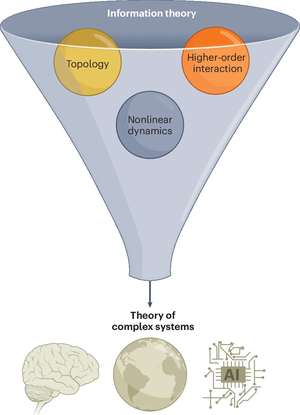
This research explores how higher-order interactions in complex systems influence the dynamics of topological signals, revealing new insights into the interplay between topology and dynamics.
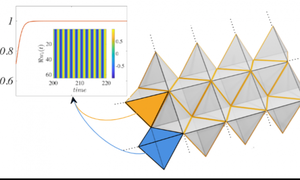
This research explores the global synchronization of topological signals on higher-order networks, revealing that topological constraints impact synchronization differently across various network structures.
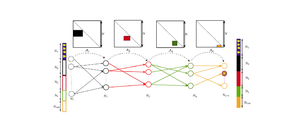
We introduce a new method for training deep neural networks by focusing on the spectral space, rather than the traditional node space. It involves adjusting the eigenvalues and eigenvectors of transfer operators, offering improved performance over standard methods with an equivalent number of parameters.
Contact me
- lorenzo.giambagli@fu-berlin.de
- Arnimallee 12, Berlin, Berlin 14195
- Enter Building, first floor